Quick Summary
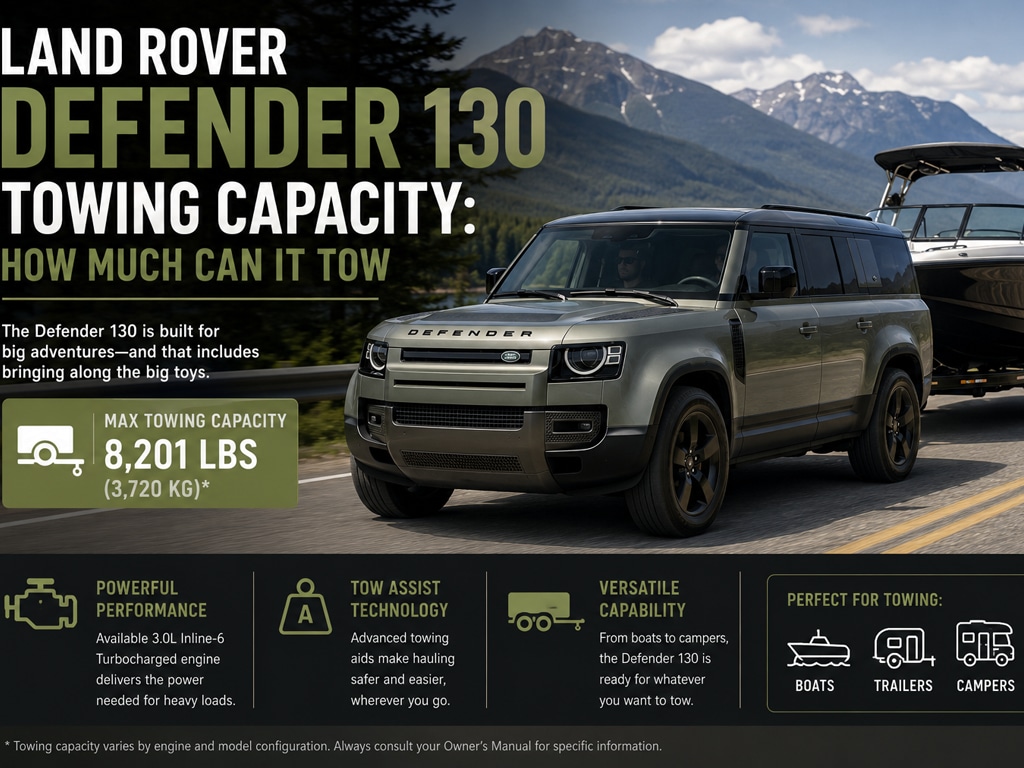
The Land Rover Defender 130 can tow up to 8,201 pounds when properly equipped. Its extended body adds stability when pulling heavy loads. Advanced features like trailer stability assist and a 360-degree camera make hitching and maneuvering simple. For families and adventurers around Solon, this SUV brings serious hauling power without giving up daily comfort.
Towing matters when you own a boat, a camper, or a trailer full of gear. You need an SUV that pulls confidently without breaking a sweat. The Defender 130 towing capacity delivers exactly that kind of muscle. We know many of our customers around Cleveland spend weekends on Lake Erie or head south with a camper in tow.
Having the right vehicle makes those trips smooth instead of stressful. Let us look at how much the new 2026 Defender 130 can pull and what helps it handle heavy loads so well.
Maximum Towing Numbers
The Defender 130 tops out at 8,201 pounds with the proper equipment. That figure puts full-size boats, horse trailers, and large campers well within reach. A typical 20-foot bowrider boat on a trailer weighs around 5,000 pounds. A midsize travel trailer often lands between 4,000 and 6,000 pounds. The Defender 130 handles both with room to spare.
Payload capacity sits at 1,831 pounds. This means you can fill the cabin with passengers, load up cargo, and still have capacity left for tongue weight from a trailer. Tongue weight should run about 10 to 15 percent of the total trailer weight. With an 8,200-pound trailer, you want roughly 820 to 1,230 pounds of tongue weight. The Defender 130 accommodates that without pushing past its limits.
Why The Extended Body Helps Towing
The Defender 130 stretches 211.7 inches from bumper to bumper. That extra length behind the rear axle gives it a longer wheelbase-to-overall-length ratio compared to shorter SUVs. A longer vehicle generally resists trailer sway better. When wind gusts hit or a semi-truck passes, the trailer exerts less leverage on the tow vehicle. You feel more planted and in control.
The electronic air suspension, available on higher trims, self-levels under load, keeping the rear end from sagging when a heavy trailer hooks up. Level ride height means headlights stay aimed correctly and steering geometry remains predictable. For families towing through hilly terrain, this feature makes a noticeable difference.
Towing Technology That Simplifies The Job
Land Rover packs the Defender 130 with helpful towing tech. The advanced tow assist system lets you steer trailer direction using a rotary dial on the center console. Instead of wrestling with counter-steering, you simply turn the dial the way you want the trailer to go. The 360-degree camera gives a clear view around the hitch, making solo hookups quick.
Trailer stability assist monitors trailer movement and applies individual brakes if it detects sway. The system reacts faster than a driver can, keeping things steady. Other tools include trailer light test functions, a tow hitch guide, and on-screen trailer angle display. If you do not need quite this much towing muscle, the new 2026 Range Rover Evoque S offers capable hauling in a more compact package. But for maximum pulling power, the Defender 130 stands tall.
What Owners Around Cleveland Can Tow
Picture a summer Saturday. You hitch up a 5,500-pound wakeboard boat and head to Lake Erie. The Defender 130 pulls it easily, and the air suspension keeps the ride smooth. Fall arrives, and you hook up a 6,000-pound camper for a weekend trip to Hocking Hills. The extended body keeps everything stable on the highway, while the 360-degree camera helps you back into a narrow campsite without a spotter.
These are real scenarios our customers live every season. You keep the refined ride, the upscale cabin, and the legendary off-road ability while adding serious hauling capability. At our showroom, you can also explore the new 2026 Range Rover Velar Dynamic SE to compare specs across the Land Rover lineup.
A Few Towing Best Practices
First, check your hitch type. A weight-carrying hitch works for lighter loads, but anything over 5,000 pounds calls for a weight-distributing hitch. This setup spreads tongue weight across both axles for better control.
Second, mind your speed. Towing puts extra heat into the engine, transmission, and brakes. Driving at moderate speeds keeps temperatures in check.
Third, pack the trailer correctly. Place about 60 percent of the cargo weight toward the front. Too much weight at the back makes the trailer fishtail. Secure all items so nothing shifts. A quick walk-around before hitting the road can save you trouble later.