Quick Summary
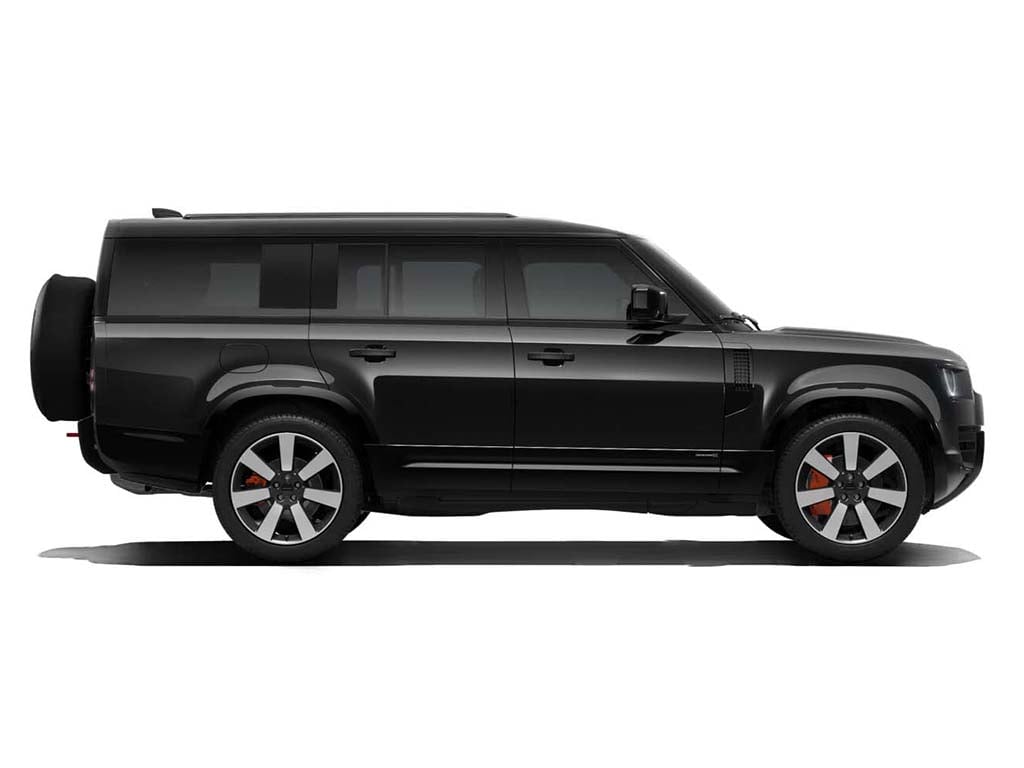
The Defender 130 offers greater passenger capacity and a standard third row, making it the better choice for larger families. The Defender 110 is easier to maneuver and delivers slightly better off-road geometry, making it a strong option for drivers who prioritize agility and trail performance.
The Land Rover Defender lineup gives Cleveland drivers two outstanding choices, and picking between them starts with one honest question: how much space do you really need? The Defender 110 is the classic silhouette, a two-row SUV with legendary off-road DNA and a shape that turns heads on every street. The Defender 130 stretches that same formula, adding a third row and more cargo room without losing the capability that made the Defender famous.
Both are exceptional vehicles, but they serve slightly different purposes. You can see the size difference up close by visiting our showroom and exploring the new 2026 Defender 130 alongside the 110 models we have in stock.
Size and Exterior Dimensions
The most obvious difference between these two Defenders is length. The Defender 110 measures 197.6 inches from bumper to bumper, including the rear-mounted spare tire. The Defender 130 stretches to 211.7 inches, a gain of just over 14 inches. All of that extra length lives behind the rear axle, which is why the 130 has a longer rear overhang and a slightly different profile.
Both models share the same width at 79.1 inches without mirrors and the same height at 77.4 inches with the standard air suspension. The wheelbase is identical at 119 inches. This means the turning circle, the ground clearance, and the overall stance feel very similar from behind the wheel. Where you notice the difference is in parking lots and tight garage spaces. The 130 takes more care to maneuver in crowded city spots, something to keep in mind if you live in a neighborhood with narrow streets.
Interior Space and Seating Capacity
Here is where the two models truly diverge. The Defender 110 seats up to five people in its standard configuration. A small third-row jump seat is available, but it is best for occasional use by children. The Defender 130 comes standard with a third row that seats three across, bringing total capacity to eight passengers with the second-row bench. Opting for the captain's chairs drops that number to seven but makes the third row far more accessible.
Cargo space also tells a clear story. With all seats folded flat, the Defender 110 offers 78.8 cubic feet of storage. The Defender 130 bumps that number to 76.1 cubic feet, which is slightly less with the third row down but still plenty for most needs. The real advantage comes when you have passengers. The 110 gives you 34 cubic feet behind the second row. The 130 gives you 35.4 cubic feet behind the second row plus the third row, with 10.2 cubic feet available even with all seats up. For families that regularly transport passengers and gear, that additional storage space behind the third row can be valuable.
Off-Road Capability
Both the Defender 110 and Defender 130 share the same body-on-frame construction and off-road hardware. The standard air suspension gives you up to 11.5 inches of ground clearance in the highest setting. Approach angles are nearly identical at 37.5 degrees for the 110 and 37.4 degrees for the 130. The difference appears in the departure angle. The shorter 110 achieves 40 degrees, while the longer 130 manages 28.5 degrees. That is the trade-off for the extra passenger space. On rocky trails with steep drop-offs, the 110 has a slight edge.
For Cleveland drivers, this difference is minor. Both models wade through up to 35.4 inches of water and come with Terrain Response 2, which lets you dial in settings for snow, mud, sand, and rock crawling. The same engines, transmissions, and four-wheel-drive systems power both vehicles. Unless you plan to tackle extreme off-road obstacles, the 130 will do everything the 110 can do on the trails you are likely to explore around Northeast Ohio.
At our Land Rover Solon service center, we keep both models trail-ready with factory-trained technicians who understand the demands of local terrain and weather.
Engine Options and Performance
Both Defenders share the same engine lineup, so you are free to pick your body style first and your power level second.
The base turbo four-cylinder makes 296 horsepower and handles daily driving without complaint. The mid-tier mild-hybrid six-cylinder is the sweet spot, with 395 horsepower and a relaxed, effortless feel on the highway. At the top, a supercharged V8 turns the Defender into something surprising. It delivers 518 horsepower in standard form and 626 in the OCTA Edition. All three engines pair with an eight-speed automatic and full-time all-wheel drive.
Fuel economy is close between the two models. The six-cylinder in the 110 returns about 18 mpg city and 23 highway. The heavier 130 dips by roughly one mile per gallon across the board. Towing capacity holds steady at 8,201 pounds for both, so neither model asks you to sacrifice utility.
Daily Driving and Comfort
On paved roads, both Defenders ride with surprising refinement. The air suspension soaks up potholes and expansion joints, a welcome trait on Cleveland's post-winter streets. Highway cruising is quiet, and the upright driving position gives you a commanding view of traffic.
The key difference is how each one feels in tight spaces. The 110 is easier to park and more nimble in city driving. The 130 requires more attention in parking garages and parallel parking situations. If your daily routine involves downtown Cleveland or older neighborhoods with narrow streets, the 110 might be the more practical companion. If you spend most of your time in the suburbs with occasional trips into the city, the 130's extra space will likely outweigh the parking inconvenience.
Both models offer the same interior quality, technology, and available features. The 11.4-inch touchscreen, wireless Apple CarPlay and Android Auto, and the full suite of driver assistance features come standard or available on both. The Cold Climate Package with heated windshield, steering wheel, and washer jets is available across the lineup, a detail that matters when the lake-effect snow arrives.
Which Defender Fits Your Life
The choice between the Defender 130 vs 110 really comes down to one thing: do you need a third row? If you have a growing family, carpool regularly, or simply want the extra passenger space for visiting relatives and friends, the 130 is the clear answer. It gives you seating for up to eight without losing the Defender's off-road soul.
If your adventures involve two to five people and you value easier parking and a slightly nimbler feel, the 110 does everything you need. It is the purist's choice, the one that stays closest to the original Defender spirit while still offering modern comfort and technology.
Our team has helped many Cleveland drivers make this exact decision. We recommend spending time in both models, sitting in every row, and taking a test drive on roads you know. You can explore our full 2025 Land Rover inventory to see which Defender configuration feels right for your life.
Frequently Asked Questions
Does the Defender 130 cost more than the Defender 110?
Yes, the Defender 130 starts at a higher base price due to the added length and standard third row. The exact difference depends on trim level and options, but you can expect to pay several thousand dollars more for the 130.
Is the Defender 130 harder to drive off-road than the 110?
Not meaningfully. The only real difference is the departure angle, which matters on very steep descents. For most off-road situations, including the trails and conditions around Ohio, both models perform at the same high level.
Can I get a two-row Defender 130?
No. The Defender 130 comes only as a three-row vehicle. If you want two rows, the Defender 110 is your option, and it still offers plenty of cargo space for most needs.
Do both models come with a spare tire on the back?
Yes. Both the 110 and 130 carry a full-size spare tire mounted on the rear tailgate. That is part of the classic Defender look and a practical feature for off-road adventures.
Which model holds its value better?
Both Defenders hold their value well compared to the broader SUV market. The 110 has a slightly longer track record, but the 130's added practicality for families makes it equally desirable on the used market.